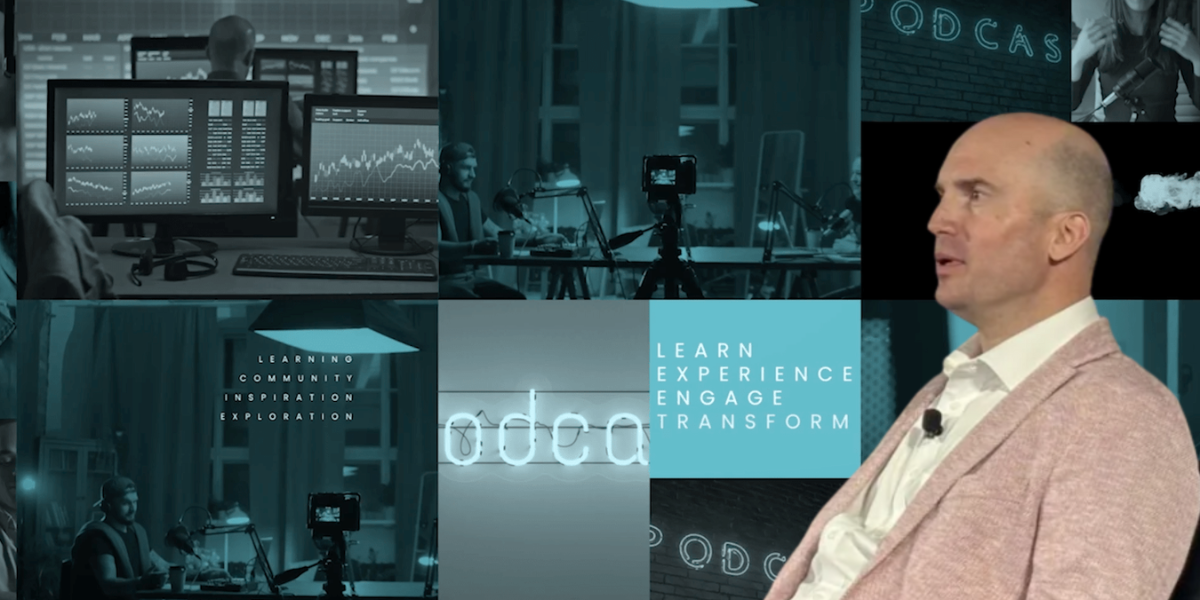



Welcome to the Force & Friction Podcast, where we break down what really moves the needle in GTM, RevOps, AI, partnerships, and SaaS growth. Today, we're diving deep into community-led growth and movement building with Jared Robin, the co-founder and CEO of RevGenius.
Jared has built something truly remarkable, growing RevGenius from zero to nearly 60,000 members over the past four and a half years, creating the largest and most influential GTM community in the world.
What makes Jared's story compelling isn't just the numbers, it's his philosophy of building something different, not better, and proving that community-first GTM strategies can drive real business outcomes.
What makes Jared's story compelling isn't just the numbers, it's his philosophy of building something different, not better, and proving that community-first GTM strategies can drive real business outcomes.
From having negative money in his bank account during COVID to building the world's largest GTM community, Jared's journey embodies the raw reality of the founder experience. His insights on audience-led growth, movement building, and the importance of validation before building have shaped how modern founders approach GTM strategy.
We explore why being different beats being better, how to build an audience before a product, the unfiltered truth about the founder journey, and Jared's predictions for the future of GTM in an AI-native world.

Jared Robin
A movement builder and community architect who has fundamentally changed how GTM professionals think about audience development and go-to-market strategy.
As the Co-Founder and CEO of RevGenius, he's created the world's largest GTM community with over 58,000 members, proving that community-led growth isn't just a buzzword, it's a sustainable business strategy..
As the Co-Founder and CEO of RevGenius, he's created the world's largest GTM community with over 58,000 members, proving that community-led growth isn't just a buzzword, it's a sustainable business strategy..
Watch the Episode:
Here are the core areas we discuss in today's episode:
1. The Founder Journey: Fear, Failure, and Finding Your Path
Jared opens with raw honesty about what really held him back from becoming a founder earlier in his career.
"What it comes down to is fears holding me back from doing things. Early in the career, I was meant to be a founder my whole career, but fear disguised as practicality led me to a career of sales. And then, having to prove things to myself led me to staying in the same company to climb the ranks."
COVID became the forcing function that pushed Jared into entrepreneurship. He found himself with negative money in his bank account, unable to get unemployment insurance, and facing the most realistic uncomfortable professional situation possible. But this rock-bottom moment became the catalyst for building RevGenius.
His insight about experience reveals a critical truth about founder resilience:
"The difference between somebody that's gone through that type of event, or done it early stage a few times, and somebody that hasn't, is literally the ability to stay in the game and be productive staying in the game."
The wins don't eliminate fear or uncertainty, they give you armor. They build confidence not in knowing the answers, but in trusting the process and your ability to figure things out when you don't have the answers.
2. Different vs. Better: The Category Creation Imperative
Jared makes a bold declaration that challenges the core strategy of most startups: stop trying to be better, start being different.
"So many founders are trying to be better or cheaper than things that are already there. If you're building a product solely to be cheaper, or better—you know, better meaning more features and stuff like that—you're competing in somebody else's market. By definition, you're going for a small sliver of a market that somebody else created. And you're not controlling that market. And, frankly, you're a commodity compared to the market leader."
The trap most founders fall into is "better disguised as different." They say things like "we're easier to use" or "we're like that company but cheaper." But competing on features or price means you're fighting for scraps in a category someone else defined and controls.
Jared's philosophy is simple but profound: create your own category. Build something that solves a problem the status quo isn't addressing. When you're different, you define the market, control the narrative, and avoid becoming a commodity competing on price or marginal improvements.
3. Audience-Led Growth: Validation Before Building
Jared champions a radical approach to de-risking startup ideas: build your audience before you build your product.
"The playbook, part of the playbook of audience-led growth is audience before product. Build trust, following, distribution either before or alongside monetization. How can I hedge? And how could I create an unfair advantage?"
His validation process is brutally simple and effective. Before creating his newsletter, he texted 120 people and got 100 to say yes, they had no idea what they were signing up for, but they trusted him enough to commit.
"If I can't get 100 people in my cell phone to say yes to signing up to my free newsletter, why the fuck am I creating it?"
This principle extends to product development. When advising a founder who had built a full app, Jared questioned why they didn't start with just a landing page to test signal first. His advice: build as little as possible.
"A Typeform is just fine for a full product, a free Typeform, or a Google Sheet or whatever. It's as complicated as it needs to be."
The more experience you gain, the more you hedge and simplify. You become less emotionally attached to your first idea, less tied to the name, and more focused on validating demand before investing resources.
4. From Community to Movement: Building Something Bigger Than a Product
Jared's success with RevGenius stems from understanding the difference between building a community and building a movement.
His early career insight came from selling the same product at FedEx versus UPS, he realized the unlock wasn't in the product features, but in building something differently. This realization became the foundation for how he approached RevGenius.
Building a movement requires authentic connection and shared purpose. It's not about tactics or growth hacks, it's about creating a space where people feel they belong to something larger than themselves.
"Common sense and connectivity comes before the tactics and the scale. You have to. That is the mode."
Jared emphasizes that social impact is a killer connector. Companies like Warby Parker and Patagonia understand this, they've built movements by authentically integrating social impact into their business models. B2B companies need to adopt this same approach.
5. AI and the Human Soul: The Future of GTM
As someone who advises AI-native companies like Regie.ai, Sweep, and Swan AI, Jared has a clear perspective on AI's role in GTM.
"AI is the cherry, AI is not the soul. You have to connect with people's souls."
The more AI automates routine tasks and enables efficiency, the more your unique differentiator becomes the quality of your human touch. Technology can scale distribution and personalization, but it can't replace authentic human connection.
Jared's vision for the future balances automation with humanity. AI will handle the mechanics, but movements are built on trust, resonance, and shared value, things that require genuine human connection.
Learn more about RevGenius Community here: 
Final Thoughts:
Jared's journey from negative bank balance to building the world's largest GTM community offers a roadmap for modern founders. His philosophy can be distilled into a few core principles:
- Accept that you have no idea what you're doing, and embrace humility earlier.
- Build as little as possible and validate with real people before investing resources.
- Focus on being different, not better, and create your own category instead of fighting for scraps.
- Build your audience before your product, establishing trust and distribution as your unfair advantage.
- And remember that common sense and human connection come before tactics and scale.
The future of GTM belongs to founders who can build movements, not just products. Those who understand that audience-led growth isn't a tactic, it's a fundamental shift in how you approach building a business.And those who recognize that in an increasingly AI-powered world, your ability to connect authentically with people's souls becomes your most valuable competitive advantage.As Jared demonstrates through RevGenius, when you combine category creation, audience-led validation, and authentic movement building, you don't just build a successful business, you change an entire industry.
Ready to be Our Next Guest Contributor?

Your Host:
A little about me, the host the show. Please connect with me on LinkedIn I'd love to have you as part of our professional network

Mike Midgley runs a portfolio career, a dynamic hands on digital entrepreneur, founder of the Scrubbing Squad, NXD, strategist, public speaker, Winning by Design certified Revenue Architect and Host at The Force & Friction Podcast.
Mike has achieved multiple exits over a 30+ year career, raised Venture Capital and franchised his businesses 68 times.