


Aug 25, 2025 Mike J Midgley

Revenue Architecture: How Customer Success Masters the Right Side of the Bowtie with SPICED | De'Edra Williams S5:E4

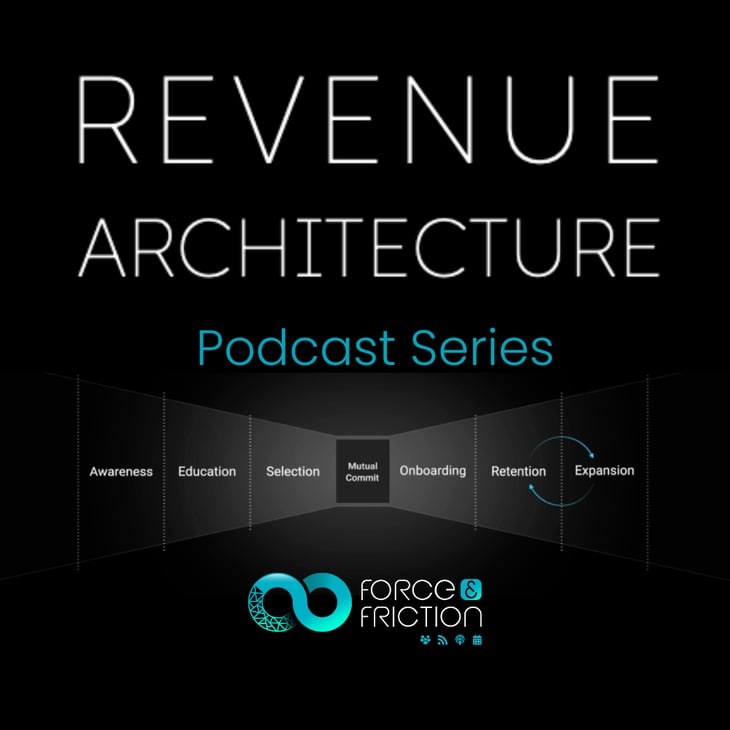
Revenue Architecture Podcast Series Graphic
 
© Bowtie and Revenue Architecture - credit Winning by Design

W
elcome to the Force & Friction Podcast, where we break down what really moves the needle in GTM, RevOps, AI, partnerships, and SaaS growth.

In this episode, we continue our Revenue Architecture series, breaking down each of the 6 models in the SPICED framework with certified Winning by Design revenue architects.

Today's guest is De'Edra Williams, a certified revenue architect and visionary leader in customer success who brings a unique perspective to the often-overlooked right side of the bowtie.

De'Edra guides us through the practical application of SPICED in customer success, showing how the right side of the bowtie can become a powerful revenue driver rather than just a cost center. With her signature "digital swagger" and Star Trek-inspired framework, she demonstrates how customer success teams can move from reactive support to proactive revenue generation.

We explore how to implement SPICED in your CRM, transform traditional QBRs into engaging customer conversations, and position customer success as a strategic boardroom function that drives measurable business outcomes.

De'Edra Williams

De'Edra is a powerhouse executive with a proven track record of driving strategic customer outcomes and maximizing revenue impact.

From leading global Customer Success teams at CompTIA to pioneering the adoption of SPICED on the right side of the Bowtie, she has helped scale customer operations, increase retention, and deliver exceptional post-sale experiences.

Watch the Episode:


What is SPICED?

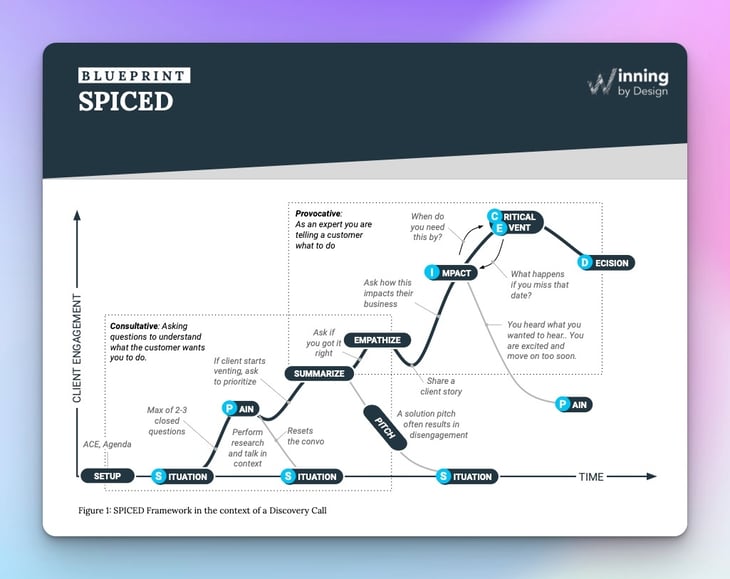
SPICED is the diagnostic framework that powers customer-centric conversations across the entire customer journey. It's the universal language that enables every customer-facing role, from marketing to sales to customer success to understand, document, and act on what truly matters to your customers at every stage of the bowtie.

Unlike traditional sales methodologies that focus primarily on closing deals, SPICED is designed for recurring revenue businesses where profits are realized through sustained customer impact over time. It shifts the focus from "Do we have budget?" to "Is this a priority?" with priority being determined by the customer's desired impact.

It is built on five foundational components that work across both sides of the bowtie:

1. Situation (S): The Customer's World Situation captures the relevant background facts and circumstances about your customer's environment. This includes company size, industry, tools they use, organizational structure, maturity level, and strategic initiatives.
 
"Situation defines the tools, people, industry, and landscape of the company. Situation questions help you understand the size of the opportunity, tools they use, and other facts to determine whether the prospect is a good fit for your solution."

On the left side of the bowtie, Situation helps qualify prospects and determine fit. On the right side, it evolves to track changes in the customer's environment that create new opportunities for expansion or signal potential churn risks.

2. Pain (P): The Problem That Drives Change
Pain addresses the acute challenges and frustrations that brought the customer to you. These can be emotional issues affecting individuals or rational issues affecting the company—cash flow problems, costly mistakes, or pipeline generation challenges.
 
"Pains are often expressed at a superficial level. To identify the true needs requires a deeper diagnosis."

Pain isn't static. On the left side, you diagnose the initial pain. On the right side, you monitor whether that pain is being resolved and identify new pains that emerge as the customer's business evolves.

3. Impact (I): The Desired Outcome
Impact reveals the core business objectives your solution helps achieve. This includes both Rational Impact (increasing revenue, decreasing costs, improving customer experience) and Emotional Impact (individual benefits like career advancement or reduced stress).
 
"Impact can be both emotional, focused on individuals, and rational, focused on the overall company."

Impact is the North Star for the entire customer journey. On the left side, you align on the desired impact. On the right side, you measure and optimize for recurring impact delivery, ensuring customers achieve their goals consistently over time.

4. Critical Event (CE): The Urgency Driver
Critical Event is the deadline by which the customer must achieve impact or suffer negative consequences. This creates urgency and drives behavior—whether completing implementation, expanding usage, or renewing contracts.
 
"Critical Events drive behavior, whether that be completing implementation, expanding use, or completing renewals or upsells."
Critical Events exist throughout the customer lifecycle. Initial events drive the purchase decision, while ongoing events drive adoption, expansion, and renewal decisions on the right side of the bowtie.

5. Decision (D): The Process and People
Decision encompasses the people involved, the process they follow, and the criteria they use to evaluate solutions. This includes understanding stakeholders, approval workflows, and success metrics.
 
"Decisions are usually made by a group of stakeholders rather than a single decision-maker."

Decision-making continues post-sale. While the initial decision focuses on purchase approval, ongoing decisions involve implementation choices, expansion approvals, and renewal commitments.


The Real Job of SPICED

SPICED's job is to create a uniform, customer-centric approach that facilitates seamless handoffs and provides a consistent, high-quality experience throughout the entire customer journey.
It defines:

How to diagnose customer needs with precision and empathy
How to align all customer-facing teams around what matters most to the customer
How to track and optimize for customer impact across the entire lifecycle
How to identify expansion opportunities and renewal risks before they become critical

It is the essential framework for moving from product-centric selling to impact-centric customer success.

Because here's the truth:
In recurring revenue businesses, the conversation doesn't end at the sale, it evolves. SPICED ensures that evolution is guided by customer impact, not internal processes, creating the foundation for sustainable, recurring revenue growth.
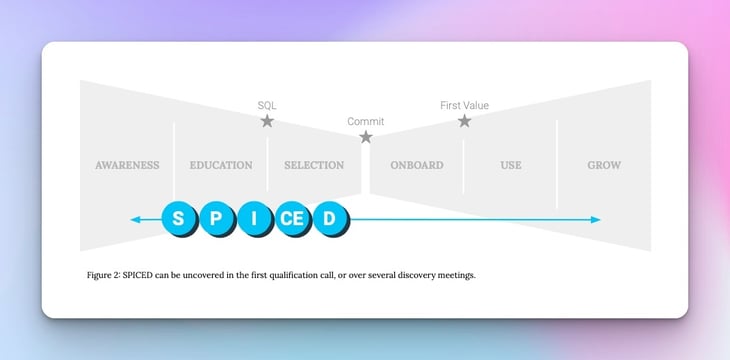

SPICED BOWTIE

Here are the core areas we discuss in today's episode:

1: SPICED Beyond Sales: The Customer Success Framework for Understanding Needs

De'Edra opens by redefining SPICED as more than just a sales methodology, it's a comprehensive framework for understanding customer needs throughout the entire journey.
 
"If I have to distill it down to a really a concise ideology for lack of a better term, it's understanding your customers needs... So that's the situation. And then what's that pain point? What is that? One thing that your product or solution is going to allow your customer to be successful. And then what's the impact if they don't address that particular pain point?"

She explains how SPICED creates alignment between sales and customer success by establishing a common language that flows from pre-sale through post-sale, ensuring continuity in the customer experience and enabling better outcomes.
 

2: From QBRs to COR's: Revolutionizing Customer Engagement
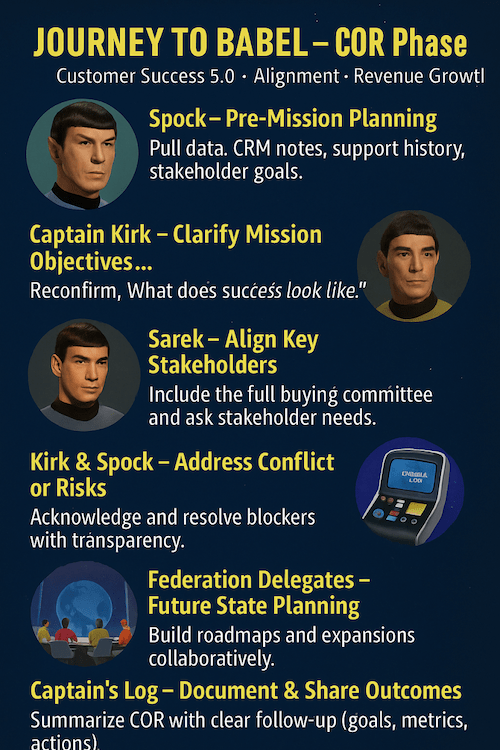
A breakthrough moment in the conversation comes when De'Edra introduces her alternative to traditional Quarterly Business Reviews, Customer Objective Reviews (CORs).
 
"I did away with QBRs. Customers don't like them, and they're an incredibly laborious process... I do what's called a customer objective review. It's called a COR. And the difference is... customers showed up. They were engaged, and they were willing to have a very thought provoking conversation that yielded a tremendous amount of results."

The COR framework focuses on three critical elements: the customer's goals and KPIs tied to your solution, their technical roadmap, and what's working well versus opportunities for improvement. This approach transforms vendor relationships into true partnerships.
 
COR Framework - DeEdra Williams


3: The Four-Phase Customer Journey: From Alignment to Advocacy
De'Edra breaks down her systematic approach to customer success through four distinct phases built into their CRM workflow.
 
"We actually built out a customer journey that started with 4 phases. The 1st phase is the align phase... and that's documenting their desired business outcomes. Building out that sort of situational piece... once that became a high probability of close, it would automatically kick it into what we call the onboarding phase."

The four phases: Align, Onboard, Engage, and Advocate, create a structured path that ensures no customer falls through the cracks while maximizing opportunities for retention and expansion at each stage.

SPICED


4: The Value Driver Mindset: Redefining Customer Success as Revenue Generation

One of the most powerful themes is De'Edra's approach to positioning customer success professionals as value drivers rather than cost centers.
 
"We are not salespeople. However, we are the owner of a revenue metric... we are value drivers, and when you identify value opportunities for your customers, you're not selling to them, you are presenting them with the opportunity to optimize the solution that they've already purchased."

This mindset shift is crucial for customer success teams who struggle with the perception that they're "not salespeople" while still being expected to drive revenue outcomes.


5: The Human-First Strategy: Balancing Automation with High-Touch Relationships

De'Edra addresses the critical balance between scalable automation and meaningful human interaction in today's hybrid GTM world.
 
"That's the difference between being a vendor and being a partner... if you really want true engagement, if you really want to drive value for your customers. You've got to identify... ICPs that really need that human interaction because it's going to drive retention. It's going to reduce and minimize churn."

She outlines three critical touchpoints that require human interaction: onboarding for enterprise customers, engagement through COREs, and customer advocacy for renewals and referrals.


Final Thoughts

De'Edra leaves us with a powerful call to action for customer success leaders who want to elevate their function from a silent engine to a strategic revenue driver.
 
"Understand your numbers... NRR, ARR, customer lifetime value, COGS, CAC. Know these acronyms by heart. When you know those acronyms, go and make friends with your CFO... I present to my boards. I don't let the CRO do it. I don't let the CFO do it. I do it myself."

Her final message emphasizes that the biggest gap in organizations isn't between sales and customer success, it's the lack of understanding from the C-suite about the revenue drivers that customer success can bring. The solution is for CS leaders to own their numbers, present their own results, and demonstrate the measurable impact of the right side of the bowtie.
 
"The close ratio for marketing qualified leads is about 2 to 3%. The close ratio for CSQLs, Customer Success Qualified Leads" is significantly higher, proving that customer success isn't just about retention—it's about driving the most efficient revenue growth in your entire GTM engine.

The Revenue Architecture Series

Watch more episodes from the Revenue Architecture Series - get started with the founder of Winning By Design Jacco van der Kooij's interview - watch that here: 
Jacco van der Kooij Podcast Hero -2024


The Revenue Architecture Textbook

Order you text workbook on Revenue Architecture - more than a 'read' this is a comprehensive workbook to ensure you up skill your knowledge.
RA book


Ready to be Our Next Guest Contributor?
F&F Podcast - Guest Contributor CTA


Your Host:

A little about Mike who hosts the show.  Please connect with me on LinkedIn I'd love to have you as part of our professional network.

MJM Bio USA

Mike Midgley runs a portfolio career, a dynamic digital entrepreneur, NXD, strategist, public speaker, Winning by Design certified Revenue Architect and Host at The Force & Friction Podcast.

Mike has achieved successful six and seven-figure exits over a 30+ year career, raised in excess of £1.6m [$2.5m] in Venture Capital and franchised his businesses 68 times.

Teal - #RevOpsLife


Stay Ahead with Mike’s Insights   Get straight to the point with actionable insights, no fluff, no spam. Subscribe to my blog for the latest strategies on navigating every stage.
Published by Mike J Midgley August 25, 2025
Mike J Midgley